If you've been trying to figure out whether to trade with a prop firm or fund your own account then you need to understand the massive difference between these two approaches so let me break this down for you in the simplest way possible.
Prop firms give you access to trading accounts worth $100,000 or more without you having to risk a single dollar of your own money now compare that to self-funded trading where you need at least $25,000 of your personal savings just to get started as a pattern day trader and the difference becomes pretty obvious.
Now here's what most people don't realize about prop firms they let you keep up to 90% of your profits but they also put you under strict rules and limitations these rules might stress you out at first but they actually help you stay disciplined and manage risk properly self-funded trading gives you complete freedom to trade however you want but your growth is limited to whatever capital you personally have.
So here's the thing about trading with prop firm money it's way less stressful than risking your own hard-earned cash and when you're not worried about losing your life savings you tend to make better trading decisions.
Now the choice between these two paths comes down to this do you want safety with some restrictions or complete freedom with higher personal risk prop firms share the risk and give you structure while self-funding gives you total control but puts all your money on the line.
Before you decide which path is right for you you need to understand how each option matches up with your trading goals your comfort with risk and how much capital you actually have available so stick around because I'm going to show you exactly how to make this decision.
Choosing Based on Trader Profile
Now your individual trader profile is going to determine which path makes the most sense for you and understanding where you fit can save you a lot of time and money so let me walk you through the different trader types and which option works best for each.
Beginner vs Experienced: Who Benefits More?
If you're just starting out prop firms are usually your best bet and here's why beginners get massive value from prop firms because they provide a structured learning environment with clear risk parameters detailed performance metrics and goal-oriented frameworks that speed up your learning curve way faster than just fumbling around with your own account plus prop firms give you guardrails that prevent the destructive habits that destroy most new traders
now experienced traders use prop firms differently they're mainly looking to scale up with proven strategies skilled traders can multiply their buying power like crazy for example you can access $250,000 in funded capital with just over $1,115 investment and experienced traders can actually run multiple funded accounts at the same time creating leverage that personal accounts just can't match.
self-funding works best if you've already mastered emotional discipline because trading your own money creates a psychological challenge that most people underestimate but if you're an experienced trader who just doesn't have enough capital then prop firms let you show your skills on a much larger scale without waiting years to build up your personal account.
Risk Tolerance: Conservative vs Aggressive Traders
Your comfort level with risk is huge when deciding between these options so let me break down the three main types.
Conservative traders risk about 0.25% per trade and prefer steady methodical growth with small drawdowns these traders actually find prop firms more comfortable because they're not stressing about risking their life savings.
Moderate traders risk around 1% per trade and balance risk with reward they usually do well in both environments but they get a big advantage from prop firms larger capital base.
Aggressive traders risk up to 2% per trade and want maximum returns while handling bigger drawdowns now prop firms officially allow this approach but you need exceptional discipline to pull it off.
here's the thing conservative traders experience way less emotional stress with funded accounts since they're not risking their own money but aggressive traders need to be careful because many prop firms have specific risk rules that might limit aggressive strategies.
Trading Goals: Skill Building vs Income Generation
if your main goal is building your trading skills then prop firms give you a structured path with clear feedback loops their evaluation processes work like learning environments with specific targets and metrics many prop firms also offer training programs and resources including trading psychologists.
but if you're focused on generating income then the math is simple would you rather keep 100% of profits on a small account or share profits on a much larger account a self-funded trader with $10,000 might make modest returns but that same capital could get you access to multiple funded accounts totaling $250,000 or more at prop firms.
now here's something interesting some smart traders actually combine both approaches they use prop firms for short-term income while building up their personal account for long-term wealth this hybrid strategy gives you the best of both worlds larger position sizes from funded accounts while keeping complete control over your personal capital.
the bottom line is your decision should match your experience level how comfortable you are with risk and what you're actually trying to achieve not just following what everyone else is doing.
Capital Requirements and Accessibility
the money you need to get started is where these two paths become completely different and this difference affects everything from how you start trading to how fast you can bounce back from losses.
Minimum Capital Needed: $500 vs $25,000+
Here's the reality about capital requirements self-funded stock traders need at least $25,000 in their accounts just to qualify as pattern day traders under FINRA regulations and most experts actually recommend between $30,000 to $50,000 so you have a safety cushion against losses.
Now prop firms have changed this game completely most funded trading accounts only require $50 to $1,000 for evaluation fees and the cost depends on what account size you're going for this means you could potentially control accounts worth $25,000 to $100,000+ after passing an evaluation for less than what most people spend on a vacation.
Funding Speed: Instant Access vs Personal Accumulation
The time it takes to get substantial capital is another huge difference self-funded traders have to go through this long accumulation phase building their accounts through personal savings or slowly growing their money and this process takes years especially if you're starting with small amounts.
but instant funding prop firms give you immediate access to significant capital once you pass their evaluation or pay the required fee one trader said "With OFP you're ready to trade immediately" so instead of waiting years to save up capital you can start trading with serious money right now if you can pass their challenge.
Backup Options: Retrying Prop Challenges vs Rebuilding Savings
Now here's something most people don't think about what happens when you lose money.
if you're self-funded and you blow up your account you have to start the whole process over again rebuilding your savings from your day job and this can be financially and psychologically devastating.
prop traders face a completely different situation if you lose a funded account you can just buy another evaluation often for the same $50 to $1,000 fee some firms even give you free retries or discounted second attempts after you fail this creates an incredible advantage self-funded traders might lose their entire $25,000+ investment while prop traders only risk their evaluation fee.
one trader actually calculated that spending $5,000 on multiple prop evaluations could give you access to $60,000 worth of trading capital which gives you way more opportunities than risking that same $5,000 in your personal account.
this is why many traders now use prop firms as stepping stones using them to generate profits that eventually help them fund their own personal accounts.
Profitability and Earning Models
Now when it comes to making money trading the financial outcomes between prop firms and self-funded accounts are completely different and this affects everything from how much you keep to how fast you can grow your account
Profit Sharing: 0% vs 20-30% to Firm
With self-funded trading you keep 100% of your profits period no splitting no sharing every dollar you make goes straight into your account and stays there this complete profit retention gives you maximum compounding power over time
prop firms work differently they take a cut of your profits usually between 10-30% which means you keep around 70-90% of what you earn and some firms will give you up to 90% profit splits especially if you're performing well and trading larger accounts
now here's the math that changes everything let's say you make a 10% return on a $2,000 self-funded account you make $200 and keep all of it but make that same 10% return on a $100,000 funded account and you make $10,000 even after giving the firm 20% you still keep $8,000 that's 40 times more profit than the self-funded account
Withdrawal Flexibility: Anytime vs Monthly Windows
If you're trading your own money you can withdraw profits whenever you want no questions asked no waiting periods you need money for rent you can take it out right now
prop firms are different most of them have specific payout schedules usually once or twice a month plus they often require you to meet certain performance targets before you can request a withdrawal like completing at least 8 trading days with 5 profitable days showing at least $50 profit
smart traders recommend taking small regular profits from funded accounts this keeps you psychologically reinforced and helps you develop good money management habits
Growth Potential: Compounding vs Scaling Tiers
Self-funded accounts can theoretically grow forever through compounding when you reinvest your profits your account can grow exponentially without any caps a trader making 8% monthly could turn $100,000 into $251,000 in a year through compounding versus just $196,000 without reinvestment
prop firms use structured scaling instead of organic growth once you prove consistent profitability they'll move you up to larger account sizes but these accounts always have maximum limits no matter how good you get
if you're self-funding use fixed fractional position sizing this automatically adjusts your trade sizes based on your account balance bigger positions when you're winning smaller positions when you're in a drawdown
Rules, Oversight, and Flexibility
Now pay close attention to this part because the rules and restrictions between these two approaches are night and day different and this could make or break your trading success
Evaluation Phases: None vs Multi-Step Challenges
with self-funded trading you can start trading immediately there's no evaluation no test no proving yourself you just deposit money and start trading but prop firms work completely different they make you go through evaluation challenges that can be one-step or two-step processes
these evaluations test if you can stay consistent across different market conditions and here's a reality check only about 3% of traders actually pass these challenges and get funded accounts so the prop firms use these evaluations to screen out traders who can't follow rules or manage risk properly
Trading Restrictions: Full Freedom vs Asset/Time Limits
When you're trading your own money you have complete freedom you can trade any strategy any time any instrument with any risk level you want there's nobody looking over your shoulder telling you what to do
but prop firms are different they have strict rules and some of these might surprise you
many prop firms prohibit overnight positions news trading and certain strategies some firms restrict your trading hours and limit which instruments you can trade most require specific risk management like mandatory stop-loss orders and here's what really gets traders in trouble some firms have hidden rules that they don't tell you about upfront
good prop firms will be transparent about all their rules but some shady companies will change requirements without warning you these restrictions exist to protect the firm's capital but they can really limit your trading flexibility
Account Termination Risks: None vs Breach of Rules
Here's something crucial to understand with your own account nobody can terminate your trading privileges the worst thing that can happen is you lose your own money but the account stays yours
prop firms are completely different they can terminate your account for rule violations and they categorize these violations into two types
number one hard breaches these result in immediate account termination things like exceeding maximum drawdown limits will get your account closed instantly
number two soft breaches these lead to position closures or temporary account freezes like exceeding position size limits
if you break risk rules hit loss limits or violate their consistency requirements you lose the funded account entirely and some firms use trailing drawdowns that move your loss limits higher as you make profits which means you can actually get terminated even when you're profitable overall
the bottom line is these restrictions often force you to change your preferred trading style to meet their requirements and that might not always be the best approach for your performance
Emotional and Psychological Impact
Now here's something most people don't want to talk about but the psychological side of trading often matters more than your technical skills and trust me the mental game is completely different when you're trading your own money versus prop firm capital
Fear of Loss: Own Money vs Evaluation Fee
Did you know that trading your own hard-earned money creates this intense emotional attachment that can completely mess with your head when you're watching your personal savings go up and down every day it creates this visceral fear that makes you do stupid things like closing winning trades too early or holding onto losing trades way too long
now with prop firm trading your financial exposure is limited to just the evaluation fee this psychological buffer lets you make way more objective decisions because you're not sitting there terrified about losing your life savings and like one trader told me "using someone else's money is oftentimes a heck of a lot less stressful"
Confidence Building: Independent Success vs Structured Support
Self-funded success builds a unique type of confidence because you know you conquered the markets completely on your own terms this independence creates deeper satisfaction when you're profitable
but here's what's interesting about prop firms they actually build confidence through their structured frameworks their evaluation processes work like skill-building exercises with clear metrics so you can track your progress the firm's rules force you to develop good trading habits that most traders struggle to maintain on their own and these structured environments help you figure out your strengths and weaknesses objectively
Stress Management: Autonomy vs Accountability
With self-funding you get complete freedom but also complete isolation you have to regulate yourself entirely which is harder than most people think you can adapt to any market condition but you also carry the full psychological weight of every decision
prop firms introduce accountability that many traders actually find helpful the firm's rules create guardrails that stop you from making emotional trading decisions this external structure forces discipline and helps you avoid common psychological mistakes but this accountability also creates unique pressure because you have to perform consistently while following all their rules
The Complete Breakdown
Alright so now that we've covered all the important differences let me give you the complete side-by-side breakdown so you can see exactly what you're choosing between
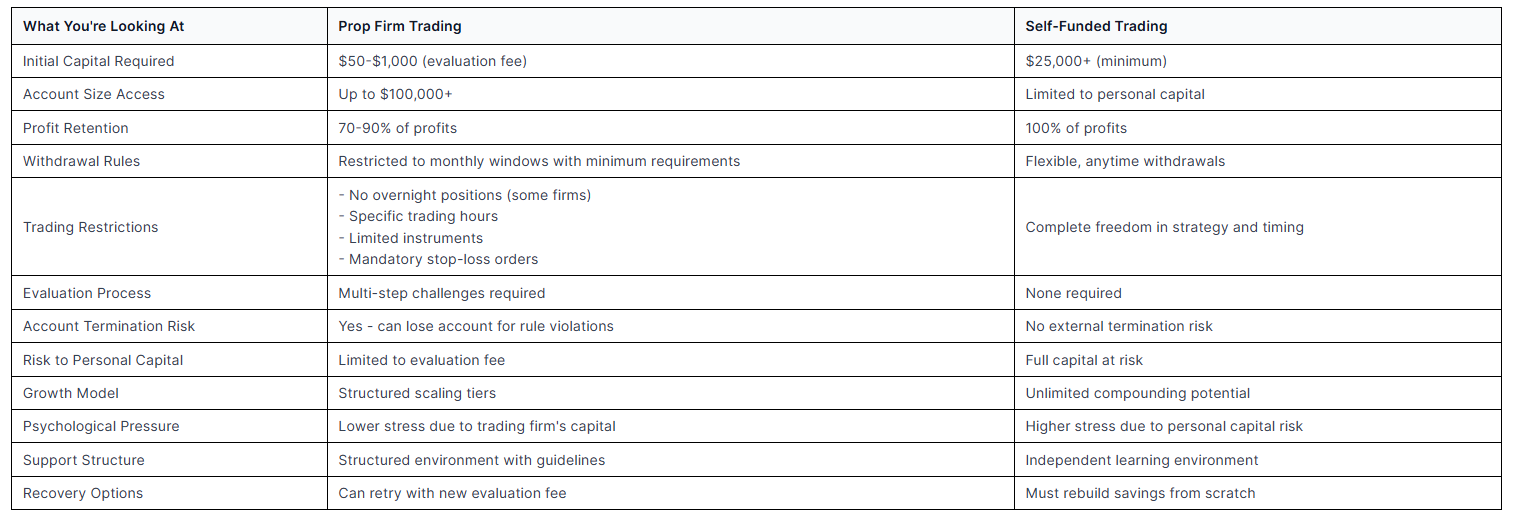
Now as you can see from this breakdown the differences are pretty massive and this is why choosing the right path for your specific situation is so importan
Making Your Decision
so after everything we've covered the choice between prop firm trading and self-funding comes down to your specific situation and what you're trying to achieve both paths can work but they're completely different journeys
prop firms give you access to serious capital with minimal upfront cost and that's a huge opportunity if you don't have much personal money to risk plus trading with someone else's money takes a lot of the emotional pressure off which usually leads to better decisions but remember you're giving up some of your profits and you have to follow their rules
self-funded trading gives you total control and you keep every dollar you make this freedom is great for experienced traders who know what they're doing but you need substantial personal capital and you're putting your own money at risk which can mess with your head
now if you're just starting out prop firms are probably your best bet because of the structured environment and lower barriers to entry experienced traders with proven strategies but limited capital can use prop firms to scale up fast but if you've got substantial capital and solid emotional discipline then self-funding might be the way to go
here's what a lot of successful traders actually do they use both approaches they start with prop firms to build skills and generate income while they're building up their personal accounts for long-term wealth this hybrid approach gives you the best of both worlds
before you make your decision you need to be honest about three things your current skill level how much capital you actually have and whether you can handle the psychological pressure of trading your own money your choice should match your specific situation not what works for someone else
whether you choose prop firms self-funding or a combination of both success still comes down to having consistent strategies staying disciplined and managing risk properly and if you want to increase your odds of success with prop firms then make sure you understand exactly how their evaluation process works and what rules you need to follow
FAQs
Q1. What are the main differences between prop firm trading and self-funded trading?
Prop firm trading allows access to large capital with minimal upfront investment, while self-funded trading requires substantial personal capital. Prop firms impose trading restrictions and take a percentage of profits, whereas self-funded trading offers complete autonomy and 100% profit retention.
Q2. How do capital requirements differ between prop firms and self-funded trading?
Prop firms typically require only $50-$1,000 for evaluation fees, potentially giving access to accounts worth $100,000+. Self-funded trading, especially for day trading stocks, requires a minimum of $25,000, with experts recommending $30,000-$50,000 as a safety cushion.
Q3. What happens if you lose money with a prop firm?
If you lose money with a prop firm, the firm absorbs the losses. You're not personally liable to repay any losses. However, if you violate risk management rules or exceed maximum drawdown limits, your account may be suspended or closed, ending your access to the firm's capital.
Q4. How does the psychological impact differ between prop firm and self-funded trading?
Prop firm trading often creates less emotional stress since you're not risking personal savings, potentially leading to more objective decision-making. Self-funded trading can be more psychologically challenging due to the fear of losing hard-earned money, but success can breed a unique type of confidence built on self-reliance.
Q5. Is trading with a prop firm worth it for beginners?
For beginners, prop firms can be beneficial due to their structured learning environment, lower financial barriers, and the psychological buffer of trading with the firm's capital. However, success still depends on developing consistent strategies, maintaining discipline, and effectively managing risk. It's important to carefully consider your goals, risk tolerance, and available capital before deciding.