If you've ever wondered how technology is changing a real estate market worth $637 trillion then pay close attention because most property professionals are missing out on fintech tools that could change everything
here's what's happening right now. Last year homeowners saw monthly mortgage payments hit $2,306 in July - an all-time high. yet the market keeps growing with analysts predicting it'll reach $727.80 trillion by 2029
now here's the interesting part. 93% of customers already use real estate websites and 73% rely on mobile apps for property searches. plus 60% of proptech companies are based right here in the US. so the technology is here but many professionals don't know how to use it
the reality is you need to understand which fintech tools will actually impact your property investments and deals this year. some will save you thousands of dollars others will help you spot opportunities everyone else misses
so I'm going to break down the 12 types of fintech applications that matter most in 2025. from blockchain deals that close in days instead of months to AI tools that value properties in seconds we'll cover exactly what you need to know
AI-Powered Property Valuation Tools
first up we have AI-powered property valuation tools and these are game changers for anyone dealing with real estate values. instead of waiting weeks for a traditional appraisal you can get accurate property valuations in seconds
Now let me explain how these work.
AI valuation key features
These AI systems use something called Automated Valuation Models or AVMs. they crunch massive amounts of data from multiple sources like:
public records tax assessments and recent sales data
property characteristics market trends and economic indicators
digital photos and property conditions through computer vision
Here's what makes them so powerful - artificial neural networks achieve prediction errors of only 13% MAPE. Zillow's Zestimates are even more impressive with a national median error rate of just 2.4%
AI valuation benefits for real estate
So why should you care about AI valuations. four big reasons.
Speed and efficiency - traditional appraisals take weeks but AI systems give you results in hours or seconds without losing quality
Cost reduction - these tools automate data collection and analysis which cuts expenses for everyone involved. plus they streamline workflows so you complete tasks faster and more accurately
Enhanced accuracy - AI analyzes millions of data points simultaneously and catches patterns humans miss. this means more accurate and objective valuations
Fraud prevention - the systems flag suspicious activity like inflated property values early in the process which protects you from bad deals
AI valuation real-world examples
Now let me show you some companies that are already using this technology successfully
HouseCanary's CanaryAI combines institutional-grade data with AI to handle everything from property valuation to market forecasting. CAPE Analytics improved valuation accuracy by 7.7% and helped clients reduce manual inspections by 50%
C3 AI Property Appraisal offers features like AI-generated sales comparisons and machine learning condition ratings based on property photos. one company using their system reduced on-site labor hours by 30%
Quantarium processes data on over 153 million property parcels in the United States using deep learning algorithms. they serve as reliable verification methods alongside traditional valuation techniques
The bottom line is AI valuation tools are already here and working. if you're still waiting weeks for appraisals you're losing time and money
Predictive Analytics for Market Forecasting
Now let's talk about predictive analytics and why it's changing how smart investors spot opportunities before everyone else catches on
here's the thing most real estate professionals are still making decisions based on what already happened. but predictive analytics tells you what's going to happen next. these tools analyze over 5,000 different market variables and can reduce forecasting errors by 68% compared to old-school methods
How predictive analytics actually works
the way these systems work is pretty straightforward. they pull data from public records property sales social media sentiment and even alternative sources you wouldn't think of. then advanced algorithms like XGBoost crunch all this information to spot patterns
what makes this powerful is hyperlocal forecasting. instead of telling you "the market is going up" these tools can predict what's happening in specific neighborhoods or even individual streets
plus you get real-time insights instead of waiting months for market reports
Why this matters for your investments
here's where it gets interesting for investors. predictive analytics helps you make superior investment decisions by showing you where property values are headed. you can spot high-potential opportunities before they become obvious to everyone else
the risk management piece is huge too. these systems run AI-driven simulations to help you anticipate market downturns before they hit. that's the difference between protecting your portfolio and getting caught off guard
Companies actually using this stuff
Skyline AI transformed commercial real estate investment by using machine learning to identify patterns traditional methods miss. their clients can now forecast asset performance and manage risks way more effectively
IBM Watson takes a different approach using natural language processing to analyze massive datasets and forecast market trends. this has helped clients anticipate downturns before they materialize
one predictive modeling solution achieved over 70% accuracy in identifying homeowners likely to sell. that company grew from 5-7 clients to over 200 businesses across the US just by giving investors better data
Redfin built an AI-enhanced forecasting tool that combines deep learning with geographical mapping. now their clients can predict housing prices and optimal market timing with much better precision
Blockchain for Transparent Real Estate Transactions
Now blockchain technology is solving one of real estate's biggest problems - you never really know if a transaction is legitimate until it's too late
here's the thing about traditional real estate deals. paperwork gets lost title histories are unclear and fraud happens more often than people admit. blockchain changes all of this by creating records that can't be tampered with
Blockchain key features
So what makes blockchain work for real estate? four main things:
Decentralized ledger - instead of one company holding your property records multiple computers store the same information securely. if someone tries to change it the system catches them
Smart contracts - these are agreements written in code that execute automatically when conditions are met. no waiting for lawyers or paperwork to process
Tokenization - you can now buy pieces of expensive properties for as little as $50. this opens up real estate investing to regular people who don't have hundreds of thousands sitting around
Immutability - once something gets recorded it stays recorded forever. nobody can go back and change the history
Blockchain benefits for real estate
The results speak for themselves.
Traditional real estate transactions take 30 to 60 days to close. blockchain deals can finish in hours. that's because smart contracts eliminate most of the middlemen who slow things down.
Plus every step gets recorded permanently. this creates a complete audit trail that proves who owned what and when. title defects affect nearly every real estate transaction today but blockchain makes these problems disappear
The cost savings are massive too. when you remove title companies and escrow agents the fees drop significantly. Sweden figured out they could save taxpayers $106 million per year just by switching their land registry to blockchain.
And fraud becomes almost impossible. the cryptographic security means nobody can forge documents or alter records.
Blockchain real world examples
Companies are already proving this works
Propy handled the first NFT house sale in the US. they managed everything from the initial offer to recording the final deed using blockchain. no physical paperwork no escrow agents needed
RealT lets people buy property tokens starting at $50. token holders get rental income based on how much they own. this makes real estate investing accessible to anyone
Sweden started testing blockchain for property transfers in 2016. their pilot program cut transaction times by more than 80% and they're now rolling it out nationwide
Virtual Reality for Property Showcasing
Now let's talk about virtual reality and why it's becoming such a game changer for property showcasing. if you're still driving clients around to show properties all day then you're missing out on technology that could save you hours every week
VR key features
Here's what modern VR systems can actually do for real estate:
Immersive visualization - buyers can walk through virtual rooms examine details up close and get a real feel for the property's layout
360° exploration - these systems show comprehensive views of living spaces with different wall colors furniture arrangements and lighting conditions
Customization options - potential buyers can visualize changes in real-time like moving furniture around or changing décor which helps them make decisions faster
Interactive navigation - users can move between different rooms and areas at their own pace without any pressure
VR benefits for real estate
So why should you care about VR technology? here are the main benefits:
properties with 3D tours spend about one-third less time on the market. that's a huge advantage when you're trying to move inventory quickly
plus virtual tours increase the likelihood of homebuyers contacting agents by 95% according to Matterport. more contact means more qualified leads
VR also lets you market properties before construction even begins. you can show buyers exactly what the finished project will look like which helps secure pre-sales
and here's something most agents don't think about - VR removes geographical barriers completely. you can now work with international buyers without them ever stepping foot in the country
VR real-world examples
Several companies are already proving this technology works:
Matterport created the industry standard for 3D virtual tours with interactive navigation. their platform is being used by thousands of real estate professionals
Redfin uses VR technology with QR codes so potential buyers can access virtual walkthroughs instantly through their smartphones
Compass incorporates virtual staging using advanced visualization techniques to create realistic digital furnishings for their listings
Keller Williams one of the largest real estate franchises has integrated VR into their marketing strategies for property viewing and competitive analysis
IoT for Smart Property Management
now let's talk about something that's changing how buildings actually work. IoT or Internet of Things is basically a network of connected devices that make buildings smarter
so here's how this works. instead of having a property manager walk around checking temperatures and systems these smart sensors do all the monitoring automatically
IoT key features
The way IoT property management systems work is pretty straightforward:
Connected sensors monitor everything in real-time - temperature humidity air quality occupancy and equipment performance
Centralized management systems put all building functions into one platform you can access from anywhere
Automated controls handle lighting HVAC and security systems that adjust based on what's happening in the building
Data analytics turn all that sensor information into insights property managers can actually use
Real-time monitoring keeps watch over building operations 24/7 with instant alerts when something goes wrong
IoT benefits for real estate
Now here's why this matters for your properties:
Enhanced energy efficiency - smart buildings cut energy consumption because systems automatically adjust based on occupancy and conditions. IoT buildings optimize energy usage by monitoring consumption patterns in real-time
Operational cost reduction - predictive maintenance from IoT sensors reduces building maintenance costs by 10-30%. you catch problems before they become expensive
Improved security - IoT access controls and surveillance give you real-time monitoring and remote management. you can respond to threats immediately
Space optimization - occupancy sensors show exactly how spaces get used so you can identify underutilized areas and overcrowded zones. this helps with better space allocation
IoT real-world examples
Here are some companies actually using this technology:
JLL equipped dozens of commercial properties with sensors tracking temperature humidity light levels occupancy and noise. their platform processes this data so property managers understand building usage and find optimization opportunities
Greystar uses IoT for predictive maintenance across residential properties. sensors monitor HVAC systems and elevators enabling repairs that minimize disruptions
WeWork uses IoT to enhance workspace comfort and productivity. their buildings have sensors monitoring space utilization air quality and energy consumption while reducing energy costs
Big Data for Investment Decision Making
now here's something most real estate investors get wrong - they're still making million-dollar decisions based on gut feelings and basic market reports when successful investors are using big data to spot opportunities everyone else misses
the way that big data works in real estate is really simple. instead of just looking at typical metrics like income and vacancy rates these systems process massive amounts of information from sources you probably never considered
Big Data key features
modern big data platforms handle several key functions:
Volume processing - Systems handle petabytes of property information, market trends, and economic indicators
Diverse data integration - Platforms combine traditional metrics with alternative sources like social media sentiment, Yelp reviews, and energy consumption patterns
Advanced analytics engines - Machine learning algorithms identify patterns and relationships beyond human detection
Hyperlocal insights - Analysis provides block-by-block differentiation rather than neighborhood-wide generalizations
Big Data benefits for real estate
Here's why this matters for your investments:
Superior valuation accuracy - When traditional variables like income and vacancy rates are used alone, they predict real estate values with only 40% accuracy. However, incorporating alternative data significantly enhances valuation precision.
Enhanced risk management - By analyzing local vacancy rates, rent trends, and economic indicators, investors can detect softening markets before they become problematic.
Targeted marketing efficiency - Data-driven approaches identify qualified leads through consumer behavior analysis, reducing acquisition costs and shortening lease-up times.
Portfolio optimization - Big data supports confident portfolio rebalancing by analyzing asset-level performance against regional demand drivers and macroeconomic indicators.
Big Data real-world examples
Some companies are already proving this works:
Zillow employs propensity modeling with machine learning to identify high-intent clients and has created extensive data pipelines to process clickstream information for their recommendation engines.
RealINSIGHT's platform leverages advanced analytics to extract actionable insights from complex datasets, enabling investors to conduct robust market research and optimize portfolio performance.
JLL's research revealed that models incorporating non-traditional data far exceed traditional analytics in explaining rent fluctuations across properties within the same zip code.
The "Starbucks Effect" discovery—where homes near Starbucks locations in Boston appreciated more than others—exemplifies how big data uncovers non-obvious investment opportunities.
Digital Twin Technology in Real Estate
Digital twin technology creates virtual copies of real buildings that update in real-time. think of it like having a complete digital version of your property that shows you exactly what's happening inside at any moment
now here's how digital twins actually work. IoT sensors throughout the building capture data on temperature humidity air quality occupancy and structural conditions. this data feeds into a 3D virtual model that you can navigate just like the real building. the digital version updates continuously so you see current conditions and can test changes before making them physically
so what makes digital twins valuable for property management. three main benefits stand out
number one is predictive maintenance. the system detects problems before they become expensive repairs. building operators using digital twins have cut maintenance costs by 10-30% because they fix issues early instead of dealing with major breakdowns
number two is energy savings. you can track exactly how much energy different parts of your building use and test energy-saving changes virtually before spending money on them
number three is better tenant relationships. tenants can access real-time building data through apps showing maintenance schedules and repair status. this builds trust because everything is transparent
now let me show you some real examples. Brookfield Properties used digital twin technology at One Manhattan West and improved both operational efficiency and tenant satisfaction. Cushman & Wakefield created digital scans of over 1,000 properties in one year and saved significant costs while improving customer service
but here's the most impressive example. Ezhou Huahu Airport used digital twins during construction and found 6,000 problems before they built anything. this saved them 200 days of construction time and approximately $45 million
the technology is working and the savings are real. if you manage properties digital twins can help you spot problems early save on maintenance costs and keep tenants happier
Fractional Investment Platforms
Now fractional investment platforms are changing who gets to own real estate. instead of needing hundreds of thousands of dollars to buy a property you can now invest in pieces of buildings for as little as $50
the way that fractional investing works is really simple. these platforms take expensive properties and break them into small digital pieces that regular investors can afford
Fractional investment key features
here's how these platforms actually work:
Tokenization - Properties get divided into digital tokens representing ownership percentages making high-value assets accessible
Specialized vehicles - Most platforms establish LLCs or SPVs to hold properties and distribute ownership
Low minimums - Investments typically start from $10-100 with some platforms offering entry points as low as $50
Professional management - Property management companies handle tenant acquisition maintenance and income distribution
Fractional investment benefits for real estate
So why does this matter for you? four main reasons:
Expanded accessibility - You don't need $500,000 to invest in real estate anymore. fractional ownership opens markets to investors who were locked out before
Portfolio diversification - Instead of putting all your money in one property you can spread it across multiple buildings in different cities
Passive income streams - You get rental income based on your ownership share without dealing with tenants or repairs
Global market participation - These platforms let you invest in properties worldwide not just in your local area
Fractional investment real-world examples
several companies are already making this work:
Arrived Homes lets you start investing at just $100 with quarterly distributions and expected returns of 9.3-13.3% annually
RealT uses blockchain for tokenizing US properties distributing rental income based on how many tokens you own
the numbers show this is growing fast. the fractional ownership market currently manages about $500 million in assets but analysts project it'll reach $5 billion by 2030
Smart Contracts for Automated Deal Closures
now smart contracts are changing everything about how real estate deals actually close. these self-executing digital agreements eliminate the biggest pain point in property transactions - waiting 30 to 60 days for deals to close when they could happen in hours
Smart contract key features
here's how smart contracts actually work in real estate:
Self-execution - Contracts automatically trigger actions when conditions are met, such as transferring ownership when payment is received
Code-based terms - Agreement parameters are written directly into programming language
Decentralized verification - Multiple computers validate transactions, ensuring security
Immutability - Once deployed, contracts cannot be altered, protecting against fraud
Cryptographic security - Robust encryption protects transaction data
The beauty of this system is it removes human error and eliminates the need for middlemen who slow everything down
Smart contract benefits for real estate
So why should you care about smart contracts? three big reasons:
Speed matters - Traditional deals take 30-60 days but smart contracts can close in days or even hours. that's a massive difference when you're trying to move fast on opportunities
Cost savings are huge - By cutting out brokers escrow agents and attorneys smart contracts reduce closing costs by 50-90%. we're talking about thousands of dollars in savings per transaction
Trust and transparency - Every participant sees the same information fostering confidence throughout the transaction. no more wondering what's happening behind the scenes
Smart contract real-world examples
several companies are already proving this works:
Propy made headlines by handling the first-ever NFT house sale in the United States. their platform manages everything from offer to deed recording all secured on blockchain technology
Dubai Land Department implemented smart contracts for property transactions reducing fraud risk through tamper-proof records
and RealT lets people buy property tokens for just $50 with rental income automatically distributed based on ownership share. that's democratizing real estate investment through smart contract automation
the numbers don't lie - when Sweden tested blockchain property transfers they shortened the process by more than 80%. that's the kind of efficiency smart contracts bring to real estate
Hyper-Personalized Real Estate Recommendations
think about how Netflix knows exactly what shows you want to watch or how Amazon suggests products you actually buy. now real estate is getting the same treatment and 71% of consumers expect recommendations that match their specific needs
this isn't just about showing you random properties anymore. these systems learn from every click every search and every property you spend time looking at
Personalization key features
here's how these smart recommendation systems actually work:
behavioral analysis - these platforms track how you interact with listings what you click on and what you ignore to understand your real preferences
custom AI solutions - the technology analyzes everything from your lifestyle to your budget to suggest properties that actually make sense for you
natural language search - you can literally type "three-bedroom house in Paris under $800,000" and get exactly what you're looking for
real-time notifications - when a property that matches your criteria hits the market you know about it immediately
dynamic learning algorithms - the more you use these platforms the better they get at predicting what you want
personalization benefits for real estate
the numbers here are pretty impressive. personalized recommendations reduce customer acquisition costs by up to 50% and AI-based search improves decision speed by 30-50%
but here's the bigger benefit - these systems pick up on preferences you didn't even know you had. maybe you always click on properties with large windows or you avoid busy streets. the AI notices these patterns and finds properties that match your actual behavior not just what you say you want
this leads to higher conversion rates because buyers connect with properties that genuinely fit their needs
personalization real-world examples
Crexi uses machine learning to analyze search patterns and show properties that are actually relevant to each user. Redfin's "Redesign" tool lets you visualize changes to a property before you even visit
Zillow takes this further by using propensity modeling to identify high-intent clients based on their search behavior. meanwhile Indonesian platform pashouses.id implemented an AI-powered semantic search system that delivers accurate results for specific queries like "Bukit Cimanggu with a maximum price of 1 billion"
the technology is here and it's working. these platforms are making property search as personalized as your social media feed
Fintech-Enabled Mortgage Platforms
Now let's talk about something that directly affects most property buyers - getting a mortgage. traditional mortgage processes take weeks and involve mountains of paperwork but fintech platforms are changing all that
Mortgage tech key features
here's what modern mortgage platforms actually do:
Automated qualification - AI systems predict loan completion with 89.4% accuracy
Digital self-service - you can submit applications and upload documents from your phone
Centralized data systems - everything connects in one platform instead of dealing with multiple parties
Instant processing - some platforms like One Day Mortgage approve loans in 24 hours
Mortgage tech benefits for real estate
the benefits are pretty clear when you look at the numbers:
Faster closings - digital processes cut closing times by up to 7 days and some borrowers get commitment letters in just one day
Lower costs - lenders save $70-225 per loan through automation which means lower fees for you
Mortgage tech real-world examples
companies are already proving this works:
Alpha Mortgage eliminated processing errors with automated workflows. ING Bank saw 60% higher customer engagement after going digital. and Ladera Lending's AI platform reduced unqualified inquiries by 21% while increasing good opportunities by 38%
the bottom line is mortgage technology makes buying property faster and cheaper
AI Chatbots for Real Estate Customer Service
Now most real estate professionals are missing out on one of the simplest ways to capture more leads and close more deals. AI chatbots handle customer inquiries 24/7 while you sleep and they're getting smarter every month
the way these systems work is really simple. they use natural language processing to have actual conversations with potential buyers and sellers
Chatbot key features
Here's what today's real estate chatbots can actually do:
Natural Language Processing – these systems understand normal human conversation so clients can ask questions naturally
24/7 Availability – your leads get instant responses even at 2 AM when you're not available
Appointment Scheduling – chatbots automatically book property viewings and sync with your calendar
Lead Qualification – they ask the right questions to identify serious buyers before passing them to you
Chatbot benefits for real estate
The numbers speak for themselves. chatbots handle up to 79% of routine questions which means you spend less time answering the same questions over and over
this automation cuts customer support costs by about 30% and here's the best part - these systems increase sales volume by up to 67% because they capture leads that would otherwise slip through the cracks
plus they support 80+ languages so you can work with clients who don't speak English as their first language
Chatbot real-world examples
companies are seeing real results with this technology
Tidio helped Endeksa reduce response times by 59% while boosting lead generation by 138%. they did this through smart pre-chat surveys that capture visitor information before routing them to the right agent
Propy uses chatbots throughout their entire transaction process giving clients instant support from the first inquiry all the way through closing
the key is these aren't just basic question-and-answer bots. they're sophisticated systems that learn from every interaction and get better at qualifying leads over time
Comparison Table
Now if you want a quick overview of how these 12 fintech tools stack up against each other here's exactly what you need to know
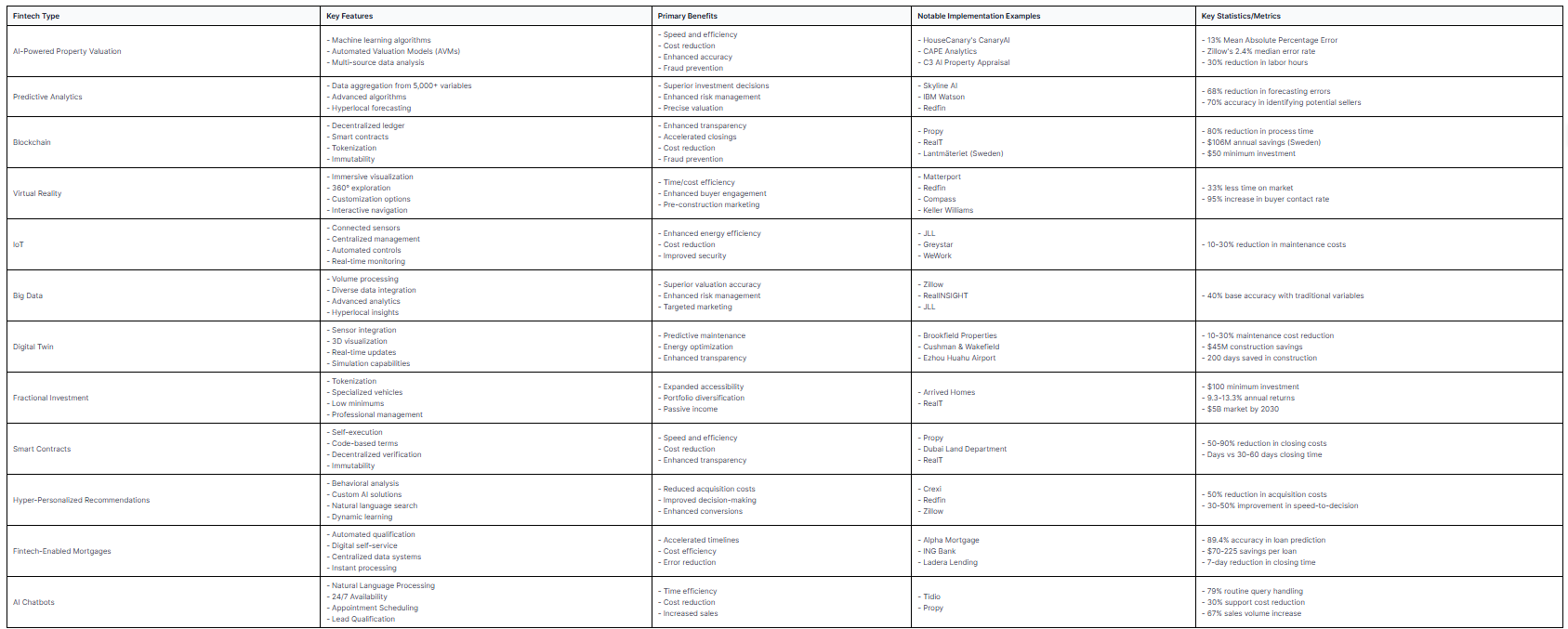
so there you have it - all 12 fintech tools broken down with the exact numbers and companies you need to know about
Here's what you need to know
Technology is changing real estate whether you like it or not. these 12 fintech tools I just covered aren't just fancy gadgets they're becoming necessary for anyone serious about property investing or transactions
AI tools value properties in seconds instead of weeks. blockchain cuts closing times from months to days. virtual reality lets you tour properties from anywhere in the world. IoT systems help you manage buildings more efficiently and big data helps you spot opportunities others miss
fractional investment platforms let you start with just $50 instead of needing hundreds of thousands. smart contracts automate deals and cut costs by up to 90%. personalized recommendations save you time by showing only relevant properties. digital mortgage platforms speed up approvals and AI chatbots handle customer questions 24/7
the real estate market is heading to $727.80 trillion by 2029 and professionals who use these tools will have a massive advantage over those who don't
so what should you do next? start with one or two tools that fit your situation. if you're an investor look at AI valuation and predictive analytics first. if you're an agent focus on VR tours and chatbots. if you're buying properties check out fractional investment platforms.
the key is to start now while your competition is still figuring things out. these technologies aren't replacing traditional real estate they're making it better faster and more profitable.
stick to this approach and you'll be ahead of the curve instead of trying to catch up later.
FAQs
Q1. How will fintech transform real estate by 2025?
Fintech will revolutionize real estate through AI-powered valuations, blockchain-based transactions, virtual property tours, IoT-enabled smart buildings, and fractional ownership platforms. These innovations will increase efficiency, reduce costs, and make real estate more accessible to a wider range of investors.
Q2. What are the key benefits of using AI in real estate transactions?
AI in real estate offers faster and more accurate property valuations, personalized property recommendations, predictive analytics for market trends, and automated customer service through chatbots. These technologies save time, reduce costs, and improve decision-making for both buyers and sellers.
Q3. How does blockchain technology improve real estate transactions?
Blockchain enhances transparency, security, and efficiency in real estate transactions. It enables faster closings through smart contracts, reduces fraud risk with immutable records, and allows for fractional property ownership through tokenization, making real estate investment more accessible.
Q4. What role does big data play in real estate investment decisions?
Big data analytics helps investors make more informed decisions by processing vast amounts of information from diverse sources. It provides insights into market trends, property values, and investment opportunities at a hyperlocal level, leading to superior valuation accuracy and enhanced risk management.
Q5. How are fintech mortgage platforms changing home financing?
Fintech mortgage platforms are streamlining the home financing process through automated underwriting, digital self-service portals, and centralized data systems. These innovations accelerate approval times, reduce costs, and improve the overall experience for borrowers, making home ownership more accessible.