Did you know that only 10.59% of traders pass the first level of a prop firm challenge, with a mere 9.26% reaching the advanced pro level? What is a prop firm challenge if not one of the most critical processes your business needs to manage effectively?
Proprietary trading has grown significantly over the last decade, with the market valued at $6.7 billion in 2020 and expected to grow 4.2% annually through 2028. At the same time, many prop firms struggle with the fundamentals of trader management. Specifically, CRM systems are meant to streamline trader onboarding, challenge tracking, payouts, and compliance yet skipping proper CRM customization can quietly stall the growth of any prop firm.
Without tailored dashboards, your prop firm can't track critical trader metrics like drawdowns, pass rates, or P&L trends making it harder to identify top talent or intervene early. In fact, a customized CRM isn't just a tech upgrade it's a strategic necessity for any prop firm aiming to scale. Here are the five most critical CRM challenges you need to overcome to stay competitive in this rapidly evolving industry.
Lack of CRM Integration with Trading Platforms
Many prop trading firms continue to operate with a fundamental disconnect in their technology stack. The trading platforms where challenges happen remain separate from the systems that manage traders and their data. This creates a significant operational gap that affects both traders and administrators.
What the challenge is ?
The core challenge is straightforward but costly: prop firms often utilize disconnected systems for trader management and actual trading activities. Without proper CRM integration, staff must manually transfer data between platforms like MT4/MT5 and the management system. This creates a workflow where every trader action, performance metric, or status change requires human intervention to be reflected across systems.
Integration challenges extend beyond simple connectivity issues. According to industry research, securing customer information becomes increasingly complex when integrating CRM systems with trading platforms. The heightened risk of data breaches necessitates stringent security measures and policies, especially when adhering to global data protection regulations.
Additionally, compatibility problems between your CRM and trading platforms can disrupt workflows and create inefficiencies. These technical hurdles aren't merely inconvenient they fundamentally limit how efficiently you can run your prop firm challenge programs.
A specialized prop firm CRM must connect directly to trading platforms like MT4, MT5, or cTrader to allow real-time performance tracking. Standard CRMs may offer basic client tracking capabilities, but they lack the specialized features needed to monitor trading activities as they happen.
Why it matters ?
The consequences of poor platform integration extend throughout your operation. Without integrated systems, your firm experiences:
Delayed decision-making: When traders submit reports manually, this causes delays and errors in processing.
Limited risk management: You cannot flag risky trader behavior before it impacts firm capital.
Inefficient scaling: Managing multiple trader accounts becomes exponentially more difficult without a unified system.
Data discrepancies: Manual syncing inevitably leads to mismatched information across platforms.
Resource drain: Staff waste valuable time on repetitive data entry rather than high-value activities.
The impact on business outcomes is measurable. One Dubai-based prop trading company improved execution efficiency by 30% after integrating its prop firm CRM with multiple trading platforms. Previously, when traders submitted reports manually, delays and errors created operational bottlenecks that limited growth.
Furthermore, the integration gap affects trader experience. Modern traders expect a seamless journey from registration through funded account status. When your systems don't communicate effectively, traders notice the friction—whether through delayed updates, inconsistent information, or manual processes that should be automated.
How to solve it ?
Solving integration challenges requires a strategic approach that balances technical requirements with business needs:
Select a specialized CRM designed for prop trading Unlike generic CRM solutions, prop trading-specific platforms are built with trading integration as a core feature rather than an afterthought. These specialized systems understand the unique requirements of challenge management, trader evaluation, and performance tracking.
Prioritize multi-platform compatibility Ensure your CRM can integrate with all trading platforms you currently use or might adopt in the future. For firms aiming to scale, a multi-platform-compatible prop firm CRM is essential for maintaining control across all trading environments.
Implement real-time data synchronization Effective integration should enable automated trade data syncing, streamlined reporting, and faster access to accurate analytics. This creates a single source of truth where trading activities are immediately reflected in your management system.
Consider security from the start Address data security concerns by implementing robust encryption, access controls, and data handling policies that comply with relevant regulations. This protects both your firm and your traders' sensitive information.
Utilize APIs and middleware solutions When direct integration isn't possible, APIs or middleware can help bridge the gap between your CRM and trading platforms. These technical solutions create communication channels between otherwise separate systems.
The most advanced prop firms are taking integration even further. Match-Trader's platform integration with YourPropFirm's CRM demonstrates how deep platform connectivity can shorten workflows for prop firms, making it easier to manage traders, track progress, and automate key processes.
Essentially, what makes integration successful is the creation of a continuous data flow where account status, trading activities, and trader performance metrics automatically populate your CRM dashboards. This enables real-time monitoring of every aspect of your prop firm challenge process.
Rather than viewing CRM and trading platforms as separate tools, consider them interconnected components of a unified trader management ecosystem. When properly integrated, they form the operational backbone that supports your firm's growth while delivering the seamless experience modern traders expect.
Inability to Track Trader Lifecycle Effectively
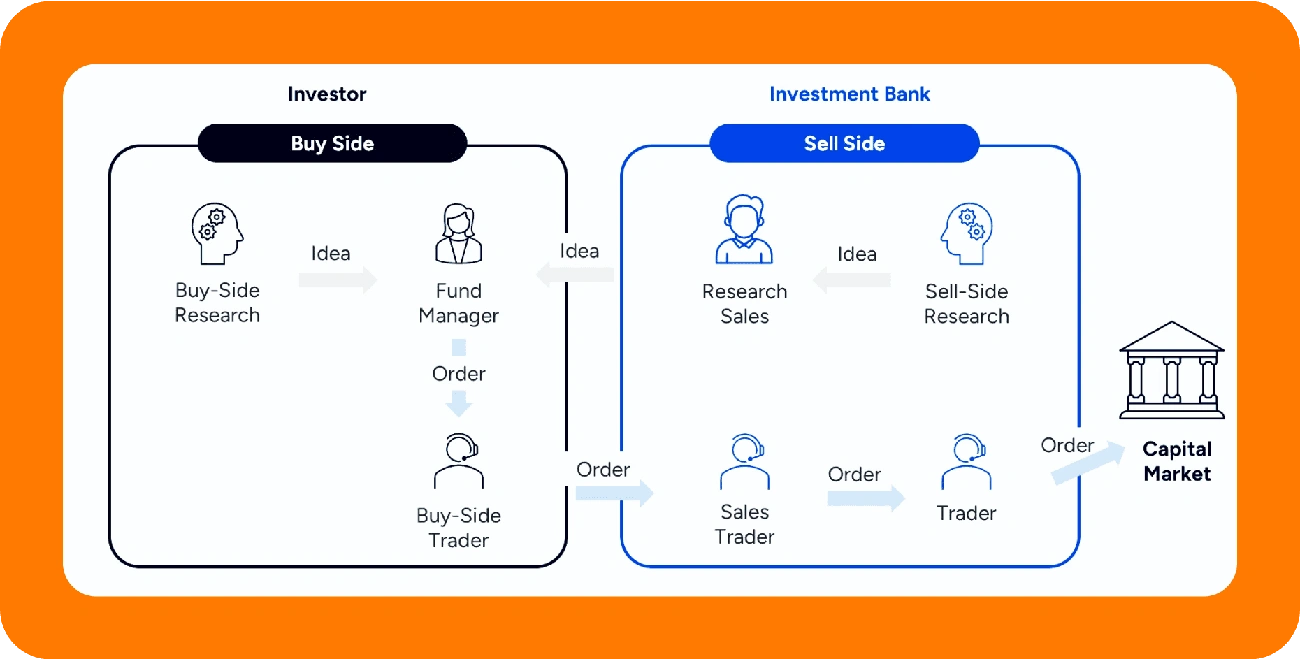
Image Source: B2CORE
Tracking a trader's journey from initial application through evaluation phases to funded status represents a fundamental challenge for proprietary trading firms. Beyond mere data collection, effective lifecycle management directly impacts retention rates, profitability, and competitiveness in an increasingly crowded marketplace.
What the challenge is
The trader lifecycle encompasses multiple critical stages: application, onboarding, evaluation phases, funding, ongoing performance, and payouts. Most prop firms struggle to track this journey comprehensively. According to industry research, without tailored dashboards, prop firms cannot effectively monitor critical trader metrics like drawdowns, pass rates, or P&L trends—making it nearly impossible to identify top talent or intervene when necessary.
The challenge manifests in several concrete ways:
Fragmented data across systems - Trader information exists in separate databases for onboarding, challenge progress, performance metrics, and payout processing
Inability to correlate behaviors with outcomes - Firms lack visibility into which trader characteristics predict success
Manual tracking processes - Staff waste valuable time piecing together trader journey data
Limited visibility into re-engagement opportunities - Failed evaluation attempts often go untracked, missing retry opportunities
Moreover, psychological factors significantly impact trader performance, yet most systems fail to incorporate these elements. Studies show 37.8% of traders struggle with "lack of discipline or self-control," 37.5% experience "emotional trading after losses," and 35% face "financial pressures". Nevertheless, standard CRM systems rarely account for these human factors.
Failure to customize your CRM for comprehensive lifecycle tracking means missing easy wins. Your system should automatically identify re-engagement campaigns, upsell opportunities, and personalized trader communication. Without these capabilities, prop firms experience higher churn rates and lower lifetime value from their trader base.
Why it matters ?
Effective trader lifecycle tracking directly impacts business outcomes in several measurable ways.
First, improving retention rates begins with understanding the complete trader journey. Research demonstrates that firms tracking "trader retention after first payout" via heatmaps can identify precisely when, where, and why traders leave. This visibility enables targeted interventions at critical dropout points.
Second, trader lifecycle data provides predictive insights. By monitoring "breach rate by challenge type," you can see what percentage of traders fail Phase 1, Phase 2, or instant funding models, broken down by challenge structure and size. These patterns help optimize challenge structures for better pass rates.
Third, comprehensive tracking enhances operational efficiency. One of the biggest challenges in running a prop firm is evaluating trader performance. You need to know who's making money, who's struggling, and who's taking excessive risks. Without proper lifecycle tracking, this assessment becomes impossible at scale.
Consequently, firms lacking trader lifecycle visibility face:
Missed opportunities to retain traders who could succeed with additional support
Inability to forecast withdrawal demands, creating cash flow uncertainty
Poor communication and diminished trader trust due to inability to personalize interactions
Limited ability to identify and nurture top-performing traders
In financial terms, research indicates that retention directly correlates with revenue. As one platform puts it: "Retention is revenue". Your CRM should empower you to retain traders and maximize lifetime value by tracking challenge status, retry behavior, purchase history, and performance impacts.
How to solve it ?
Implementing effective trader lifecycle tracking requires strategic technological and process improvements:
Implement purpose-built prop trading CRM solutions
Generic CRM platforms lack the specialized features needed for trader lifecycle management. Select a system specifically designed for "complete trader lifecycle management with automated onboarding, KYC verification, performance tracking, and intelligent segmentation for funded traders". These specialized platforms understand the unique stages from evaluation to funding.
Develop comprehensive trader performance analytics
Integrate "advanced performance tracking with real-time P&L monitoring, drawdown analysis, and comprehensive trader evaluation metrics". Your system should automatically track each trader's performance metrics, including profitability, win rates, risk management practices, and evolution over time.
Automate lifecycle stage transitions
Manual tracking creates gaps and delays. Implement systems that automatically transition traders between lifecycle stages based on performance criteria. This should include "automated 1-step and 2-step evaluations, tracking minimum trading days, and alerting traders when they pass or fail".
Build psychological support into your tracking
Given that 40% of traders battle mental challenges, incorporate psychological support resources into your lifecycle management. Track engagement with resources like trading psychology content, as over 43% of traders report listening to podcasts about mindset and psychology, while 41.5% maintain journals to build self-awareness.
Create intelligent segmentation and personalization
Implement "eligibility triggers for offers and reactivation" and "in-CRM notifications and filters for retry workflows". This allows sales, support, and management teams to access real-time challenge insights to increase conversion and reduce drop-offs.
Integrate risk monitoring within lifecycle tracking
Ensure your lifecycle management includes "real-time risk monitoring with automated rule enforcement, position sizing controls, and instant account suspension capabilities". This integration provides early warning signals when trader behavior deviates from successful patterns.
Implement automated payout management
Complete the lifecycle tracking with "automated profit sharing calculations, payout scheduling, and integrated payment processing for seamless trader compensation". This ensures the reward phase of the lifecycle occurs smoothly.
By implementing these solutions, your prop firm can transform trader lifecycle management from a fragmented, manual process into a strategic advantage. Through comprehensive tracking of each trader's journey, you'll identify opportunities for intervention, retention, and growth that directly impact your bottom line.
Limited Automation in Onboarding and Payouts
For prop trading firms scaling beyond a handful of traders, manual onboarding and payout processes quickly become operational bottlenecks. These administrative functions—often overlooked when discussing what is a prop firm challenge—can dramatically impact growth potential and trader satisfaction.
What the challenge is
The core issue stems from prop firms carrying massive administrative burdens related to trader management. Prior to automation solutions, firms typically struggle with manually handling e-commerce back offices, onboarding new traders, and effectively managing payouts. This challenge manifests in several crucial ways:
Manual data processes create consistent problems:
Entering and verifying trader information manually leads to errors that slow down the onboarding process
Staying compliant with KYC and KYB requirements without automation is exceptionally difficult
Calculating and distributing profits to successful traders becomes increasingly complex at scale
Even established prop firms often rely on spreadsheets or generic SaaS tools that weren't designed for the unique requirements of prop trading. This creates a situation where staff must manually track challenge stages, verify documentation, and calculate profit distributions—processes that should be automated.
The administrative burden extends beyond just the initial setup. Throughout the prop firm challenge process, firms must track performance metrics, ensure compliance with trading rules, and manage payouts for successful traders. Without specialized automation, these tasks consume disproportionate staff time and resources.
Why it matters ?
The impact of limited automation on your prop trading firm is both immediate and far-reaching:
Efficiency and time management suffer significantly. Manual onboarding processes create delays that frustrate traders. One UK-based forex prop firm dramatically improved its onboarding process after adopting automated compliance systems, reducing account approval times from 48 hours to just 6 hours. This improvement directly enhanced trader satisfaction.
Payout efficiency directly impacts trader loyalty. Timely and accurate profit distribution is essential for building trader trust. A Singapore-based prop trading firm cut payout-related disputes by 50% after implementing automated payout systems with real-time dashboards showing individual profit shares and withdrawal statuses.
Operational costs increase unnecessarily. Without automation, prop firms need more staff to handle routine tasks. Advanced automation allows firms to streamline financial operations, reduce administrative burdens, and focus more on growth and trader development.
Compliance risks increase with manual processes. KYC/AML requirements have become more stringent globally. Manual verification processes are both slower and more error-prone than automated solutions, creating potential regulatory exposure.
Perhaps most importantly, the quality of your trader experience directly impacts retention rates. Modern traders expect seamless digital experiences when attempting to pass prop firm challenges. Clunky, manual processes signal outdated operations and damage credibility among sophisticated traders.
How to solve it ?
Implementing effective automation for onboarding and payouts requires a strategic approach:
Implement specialized onboarding automation
Adopt systems that facilitate automated KYC/AML checks, real-time document verification, and instant approvals. These specialized tools ensure traders can begin their prop trading challenge without unnecessary delays. Look for solutions that utilize digital forms and e-signatures to streamline entry procedures.
Automate payout processes completely
Your CRM should automate payout calculations and disbursements based on predefined rules. This eliminates manual errors and reduces the potential for disputes. The most advanced systems offer multi-currency support and processing times under 12 hours.
Integrate compliance throughout automated workflows
Effective automation doesn't just speed up processes—it enhances compliance. Look for built-in KYC/AML modules, secure document handling, and integration with third-party verification APIs. This makes compliance painless, particularly for international traders.
Utilize real-time performance monitoring
Automated systems should track trader activity, enforce risk parameters, and protect firm capital with automated controls. Set custom rules for drawdowns, leverage, and position sizing to ensure disciplined trading across all challenges.
Establish clear benchmarks for onboarding efficiency
Track progress through established benchmarks to speed up competency acquisition. This helps identify areas where traders encounter difficulties so you can continuously improve your onboarding process.
The most comprehensive solutions fully automate all administrative processes through integrated technology. This allows prop firms to focus on attracting and qualifying new traders rather than paperwork. With proper automation, your team can concentrate on strategic growth initiatives instead of routine administrative tasks.
By implementing these solutions, your prop firm can transform onboarding and payout processes from administrative burdens into competitive advantages. Your traders will notice the difference—and your operational team will thank you.
Poor Compliance Monitoring and Risk Alerts
Compliance and risk management form the foundation of any successful prop trading operation. Yet many firms continue to operate with inadequate monitoring systems that fail to provide real-time insights into trading activity and potential rule violations.
What the challenge is ?
Effective risk management is a core element of prop trading, yet generic CRM systems typically lack the sophisticated capabilities needed for real-time risk monitoring and limit enforcement. Without proper compliance tools, prop firms face multiple vulnerabilities:
First, standard CRMs cannot track or flag unusual trading patterns that might indicate rule violations. This creates significant blind spots where risky behavior goes undetected until financial damage occurs. One U.S.-based firm reduced capital losses by 35% after implementing a prop firm CRM equipped with intelligent risk alert systems that automatically flagged risky behavior before accounts were compromised.
Second, most prop trading firms require bespoke risk management solutions tailored to their specific strategies and risk appetite. Generic systems fail to accommodate these specialized needs, forcing firms to rely on manual oversight that doesn't scale as trader numbers increase.
Third, the challenge extends to regulatory adherence. Prop trading firms are subject to stringent regulatory requirements, yet generic CRMs rarely offer the specialized compliance and reporting tools necessary to meet these obligations. As regulatory pressure on prop trading firms continues to grow, particularly under CFTC, SEC, and MiFID II, firms engaging in high-frequency or algorithmic trading face increasing scrutiny regarding market manipulation.
Finally, without a dedicated risk management interface serving as a centralized control hub, prop firm administrators lack real-time monitoring capabilities to detect and address trader violations effectively. This becomes increasingly problematic as firms scale—what begins as a manageable issue with a handful of traders becomes an operational nightmare with hundreds.
Why it matters ?
The implications of poor compliance monitoring extend beyond mere administrative concerns. Foremost, compliance risks increase substantially when your CRM cannot monitor or flag unusual trading activity. This puts the firm at risk of missing key compliance events and failing audits.
Likewise, without real-time updates, firms cannot respond swiftly to take necessary action—such as issuing warnings or deactivating accounts—to ensure a fair and compliant trading environment. This delayed response time exposes the firm to potential losses and reputational damage.
From a regulatory perspective, failing to implement robust compliance monitoring creates exposure to enforcement actions. Modern compliance systems automate regulatory adherence through features like pre-trade compliance checks against position limits, automated alerts for risk parameter breaches, transaction recording for audit trails, market abuse detection algorithms, and real-time reporting to regulatory bodies.
Furthermore, as your prop firm scales, maintaining visibility into trading risk becomes increasingly difficult without automated systems. Firms that successfully scale implement tools to set risk thresholds and receive notifications of any breach in real time—ensuring that increasing trader numbers do not dilute risk oversight.
The financial impact is substantial. Without tailored dashboards, a prop firm cannot track critical trader metrics like drawdowns, pass rates, or P&L trends—making it harder to identify top talent or intervene early when problems arise.
How to solve it ?
Addressing compliance monitoring challenges requires implementing specialized systems with several key capabilities:
Implement dedicated risk management interfaces
Deploy a centralized control hub providing prop firm administrators with real-time monitoring capabilities to detect and address trader violations effectively. These interfaces should offer comprehensive dashboards showing all active positions, rule adherence, and potential violations.
Utilize automated risk management tools
Implement systems that enforce rules like daily loss limits or leverage caps in real time. These should trigger alerts or halt trading when thresholds are breached, protecting the firm without requiring constant manual oversight. Automated risk alerts within your CRM enable risk managers to respond immediately when traders breach predefined thresholds—helping prevent avoidable losses.
Integrate compliance automation
Automate critical compliance processes such as Know Your Customer (KYC) and Anti-Money Laundering (AML) protocols to streamline operations, reduce risk, and improve efficiency. These automated systems provide real-time monitoring, making it easier to detect suspicious activity and mitigate risks promptly.
Deploy automated trade surveillance
Implement systems that monitor trading activity in real-time to detect unusual patterns or manipulative behavior. By analyzing trading data, surveillance tools identify red flags such as insider trading or market manipulation, allowing compliance teams to investigate and take action before regulatory issues arise.
Seek specialized CRM solutions with risk integration
Choose CRM systems that seamlessly utilize risk management tools to detect account sharing, copy trading, and other rule-breaking activities. The right CRM can automate operations, manage cheating risks, and centralize all user activity in one dashboard.
The most advanced solutions flag suspicious activity with built-in risk tools for real-time monitoring. If unusual trading patterns are detected, these systems flag accounts for review and can halt payout requests automatically, providing essential protection against both financial and reputational damage.
Ultimately, effective compliance monitoring represents the difference between an average and a top-performing prop firm. By implementing these solutions, you ensure your prop firm challenge remains fair, transparent, and protected from both internal and external threats.
Generic Communication and Low Trader Engagement
Effective trader engagement remains elusive for many prop trading firms, with most relying on one-size-fits-all communication that fails to address the unique needs of their trader community. Impersonal, generic messaging creates distance between firms and traders at precisely the moments when personalized support matters most.
What the challenge is
The fundamental issue is that standard CRM systems lack the specialized features needed to facilitate meaningful trader engagement. Most prop firms struggle with:
Disconnected communication channels that scatter trader interactions across email, chat, and phone without centralization
Generic messaging that fails to segment traders by their stage in the evaluation process
Poor psychological support despite evidence that 37.8% of traders struggle with "lack of discipline or self-control" and 37.5% experience "emotional trading after losses"
Information overload through unfiltered notifications that traders find "noisy and annoying" rather than helpful
Attempting to manage trader communications through generic CRMs creates an impersonal experience. Indeed, traders receive identical messages regardless of whether they're prospecting, currently in a prop firm challenge, or already funded. Without segmentation capabilities, firms cannot tailor their approach based on trader needs or performance.
Furthermore, communication issues extend beyond mere convenience—they directly affect trader psychology. Alongside financial pressures (affecting 35% of traders), psychological factors significantly impact trader performance. Yet standard communication systems fail to address these human elements.
Why it matters ?
The impact of poor communication and engagement extends throughout the trader lifecycle:
First, engagement directly affects retention rates. Although 94% of traders enjoy being active investors and 96% plan to continue long-term, poor communication experiences can drive them to competing firms. Since traders frequently juggle multiple prop firms simultaneously, creating a differentiated experience through personalized communication becomes crucial for loyalty.
Second, inadequate engagement increases trader churn. Firms that can't segment and personalize trader communication risk losing trust. This challenge becomes even more apparent during critical moments like evaluation failures or periods of underperformance—precisely when targeted, supportive communication could prevent churn.
Third, psychological support represents an underutilized engagement opportunity. Many traders already seek such resources independently, with 43% listening to podcasts about mindset and psychology, 41.5% maintaining journals, and nearly 40% reading self-help books. Firms that integrate these elements into their communication strategy address a genuine trader need.
How to solve it ?
Addressing trader engagement challenges requires a multi-faceted approach:
Implement centralized communication management
Adopt a CRM system that centralizes all communication channels—email, chat, phone—into a single platform, ensuring interactions are logged, tracked, and accessible. This provides a complete view of each trader's history and needs.
Develop trader segmentation strategies
Group traders by stage (prospects, in evaluation, funded, retry) to send relevant updates, promotions, or guidance. This enhances engagement by ensuring communications match the trader's current situation and needs.
Deploy customizable trader dashboards
Provide personalized dashboards where traders can easily access vital metrics relevant to their prop firm challenge. These real-time capabilities offer comprehensive snapshots of progress, keeping traders informed and engaged.
Integrate AI-driven content personalization
Implement systems that deliver content based on each trader's interests and trading patterns. This ensures traders receive information relevant to their specific trading style and goals.
Redesign notification systems
Create separate communication channels for different purposes (support, news, announcements) to prevent information overload. This allows traders to manage their engagement preferences while still receiving critical updates.
By implementing these solutions, prop trading firms can transform trader engagement from a weakness into a competitive advantage, creating stronger relationships that support both trader success and firm growth.
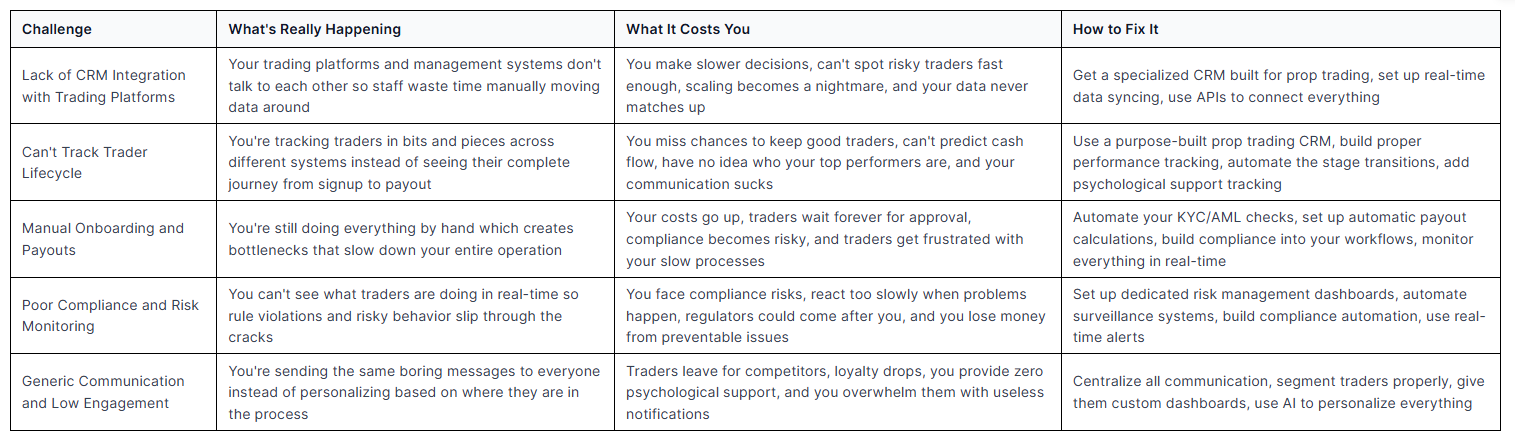
Comparison Table
Conclusion
Addressing these 5 critical CRM challenges stands as a defining factor between struggling prop trading firms and those positioned for sustainable growth. Throughout this article, we've explored how disconnected systems, fragmented lifecycle tracking, manual processes, inadequate risk monitoring, and generic communication create significant operational bottlenecks that limit your ability to scale effectively.
The consequences of neglecting these challenges certainly extend beyond mere inconvenience. Your firm risks increased operational costs, delayed decision-making, higher trader churn, compliance vulnerabilities, and ultimately, missed growth opportunities. Additionally, the competitive nature of the prop trading industry means traders will naturally gravitate toward firms offering smoother experiences and better support.
Despite these challenges, solutions exist that can transform your CRM from a basic contact database into a strategic asset. Purpose-built prop trading CRMs with real-time platform integration, automated lifecycle tracking, streamlined onboarding and payouts, robust compliance monitoring, and personalized engagement tools provide the foundation needed for operational excellence.
Remember that a specialized CRM isn't simply a technology upgrade it represents a fundamental business advantage. Your prop firm's ability to identify promising talent, maintain regulatory compliance, automate routine tasks, and create meaningful trader relationships directly impacts your bottom line.
The prop trading firms poised for success will undoubtedly be those that recognize these CRM challenges as opportunities rather than obstacles. While implementing comprehensive solutions requires initial investment, the long-term benefits reduced operational costs, improved trader retention, enhanced compliance, and increased scalability far outweigh the upfront expenses.
Your CRM strategy therefore deserves the same attention as your trading strategies. Through thoughtful implementation of specialized systems that address these five critical challenges, your prop trading firm can create sustainable competitive advantages in an increasingly crowded marketplace.
Key Takeaways
Prop trading firms face five critical CRM challenges that can make or break their operational success and growth potential.
• Integrate your CRM with trading platforms - Disconnected systems create 30% efficiency losses and prevent real-time risk monitoring of trader activities.
• Track the complete trader lifecycle - Only 10.59% of traders pass initial challenges, making comprehensive journey tracking essential for retention and profitability.
• Automate onboarding and payouts - Manual processes increase operational costs and reduce trader satisfaction; automation can cut approval times from 48 to 6 hours.
• Implement real-time compliance monitoring - Automated risk alerts can reduce capital losses by 35% and prevent regulatory violations before they occur.
• Personalize trader communication - Generic messaging increases churn rates; segmented, targeted engagement addresses the 37.8% of traders struggling with discipline issues.
The difference between struggling and thriving prop firms lies in choosing specialized CRM solutions over generic systems. Purpose-built platforms transform these operational challenges into competitive advantages, enabling sustainable growth in an increasingly crowded marketplace.
FAQs
Q1. What is a prop firm challenge?
A prop firm challenge is a process where traders demonstrate their skills to potentially gain access to trade with a proprietary trading firm's capital. It typically involves meeting specific performance targets within set risk parameters over a defined period.
Q2. What percentage of traders typically pass prop firm challenges?
Industry estimates suggest that only about 5-10% of traders successfully pass prop firm challenges. This low success rate highlights the rigorous nature of these evaluations and the high standards required by proprietary trading firms.
Q3. What are the main risks for prop trading firms?
One of the biggest risks for prop firms is inadequate risk management, especially as they scale and attract more professional traders. There's a particular risk of experienced traders exploiting weak risk controls to maximize their payouts, potentially leading to significant losses for the firm.
Q4. How can traders increase their chances of passing a prop firm challenge?
To improve their chances of success, traders should focus on mastering risk management, developing a consistent trading strategy, maintaining emotional control, and choosing a prop firm that aligns with their trading style. Consistency and disciplined adherence to trading rules are crucial.
Q5. Why is CRM integration important for prop trading firms?
CRM integration is critical for prop trading firms as it enables real-time monitoring of trader activities, streamlines operations, and enhances risk management. Proper integration can improve efficiency by up to 30%, allowing firms to make faster decisions and manage trader performance more effectively.