Prop firm tech has experienced a massive boom recently due to advances in technology, increased market accessibility, and the emergence of online prop trading platforms. I've spent the past year testing dozens of solutions, and let me tell you - choosing the right technology stack can make or break your trading operation.
The retail Forex audience has grown astronomically since the 2020s, consequently driving demand for sophisticated trading infrastructure. Additionally, CRM technology has evolved far beyond basic customer management in 2025, now handling complex tasks like client onboarding with KYC processing and seamless integration with Trading Platform 4 and 5. However, this growth introduces complexity that can threaten operational control and brand reputation.
As a funded prop trader managing multiple accounts, I've learned firsthand that a well-integrated prop trading CRM system is the backbone of any successful prop firm. Whether you're running a futures prop firm tech operation or looking for a comprehensive prop firm technology provider, automation has become the foundation of modern, scalable prop firms.
So what separates the best prop trade tech from the rest? After rigorous testing of every platform I could get my hands on, I've compiled this definitive list of solutions that actually deliver results in 2025.
Prop Trading CRM Systems
A prop trading CRM system serves as the nerve center for proprietary trading operations, far surpassing basic contact management functionality. This specialized software acts as the operational backbone connecting all departments across prop trading firms, integrating seamlessly with evaluation platforms, trading servers, and payment systems.
What is a prop trading CRM system
Unlike generic customer relationship tools, a prop trading CRM is specifically engineered for the unique requirements of proprietary trading environments. Essentially, it's a comprehensive platform that connects operations, sales, trader support, and analytics into one unified system tailored to modern prop trading needs. Furthermore, this specialized software enables firms to progress beyond cumbersome spreadsheets and manual processes, centralizing everything from evaluations to funded account approvals through a single backend interface.
Why prop trading CRM matters
The significance of dedicated CRM systems in prop trading cannot be overstated. First and foremost, these systems automate critical workflows, minimizing human error while maximizing operational efficiency. Moreover, they provide unprecedented visibility into trader performance, enabling immediate risk assessment and management.
For growing prop firms, a robust CRM dramatically improves scalability—allowing management of thousands of traders across continents with minimal staff intervention. Without proper CRM implementation, prop firms often struggle with manual onboarding, delayed payouts, lost data, and missed rule violations.
A well-designed system also enhances trader experience through streamlined onboarding, transparent performance tracking, and consistent communication. This transparency builds trust and loyalty, crucial elements for long-term success in competitive trading environments.
Key capabilities of prop trading CRM
The most effective prop trading CRM solutions offer several essential capabilities:
Automated Onboarding: Seamless KYC/AML verification, document processing, and instant approvals
Risk Management: Real-time monitoring of leverage, drawdowns, and trade limits
Performance Analytics: Comprehensive insights into trader metrics, profitability, and strategy effectiveness
Profit Distribution: Automated calculation and disbursement of earnings based on predefined rules
Challenge Tracking: Automated evaluation flows with rule enforcement and milestone notifications
Platform Integration: Connectivity with MT4, MT5, cTrader and other trading platforms
Multi-tier Management: Handling complex IB structures with complete visibility
Considering the complexity of proprietary trading operations, a purpose-built CRM becomes not merely advantageous but absolutely necessary for sustainable growth and operational excellence.
Trader Dashboard Interfaces
Modern trading environments demand visual clarity and instant access to critical information. Throughout my testing of various prop firm tech solutions, I've found that trader dashboards consistently differentiate the exceptional platforms from the mediocre ones.
What is a trader dashboard
A trader dashboard serves as your command center, consolidating essential data from multiple sources into one easily accessible visual interface. These dashboards transform complex market data into intuitive charts, graphs, and tables that allow you to interpret information rapidly without sifting through raw numbers. For prop firm technology providers, creating effective dashboards requires balancing comprehensive information with clean, uncluttered design.
Why dashboards improve performance
Dashboards dramatically improve trading performance by addressing the information overload problem that plagues many traders. According to a 2024 survey, 71% of retail participants listed rapid site speed as a top priority for daily trading activity. Primarily, well-designed dashboards enable you to understand critical information within five seconds of viewing, giving you a competitive edge during volatile market conditions.
Performance dashboards also combat cognitive fatigue. Rather than juggling multiple spreadsheets, you can monitor positions, analyze trends, and execute trades from a unified interface. This visual clarity typically results in better decision-making and faster reaction times to market shifts.
Key features of trader dashboards
The most effective prop trade tech dashboards incorporate several essential features:
Real-time data streaming: Instant access to price movements, volume trends, and market conditions without delay
Customizable layouts: The ability to arrange widgets according to your trading style and preferences
Technical analysis tools: Interactive charting with indicators, drawing tools, and pattern recognition
Portfolio monitoring: Real-time tracking of positions, performance metrics, and risk exposure
Alerts and notifications: Customizable alerts for price movements and market conditions
Notably, progressive disclosure—presenting essential information upfront while allowing drill-down into details—prevents cognitive overload. Additionally, futures prop firm tech increasingly incorporates mobile-responsive designs, ensuring you can monitor positions and receive alerts even when away from your desk.
The best prop firm technology providers understand that effective dashboards strike a balance between data richness and visual simplicity, turning complex information into actionable insights.
Automated Risk Management Tools
In the high-stakes world of proprietary trading, effective risk controls separate sustainable firms from those that quickly flame out. Automated risk management has become a cornerstone of successful prop firm tech implementation in 2025.
What is automated risk management
Automated risk management involves continuous monitoring and evaluation of financial risk exposure across trading positions and portfolios. This technology-driven approach leverages advanced algorithms to streamline risk identification, assessment, mitigation, and reporting throughout the risk management lifecycle. The system analyzes market data, position changes, and potential exposures in real-time, ensuring compliance with predetermined risk thresholds.
Why risk automation is essential
The need for automated risk controls has intensified as prop firms scale their operations. Primarily, these systems offer faster response times, allowing for instantaneous reactions to market events and significantly reducing potential losses.
Beyond speed, consistency represents another critical advantage. Manual processes simply cannot match the uniform enforcement of risk policies that automation provides across all traders. This consistency becomes increasingly vital as your prop firm expands to supervise more traders simultaneously.
Financial protection forms perhaps the most compelling reason for implementation. Consider a prop firm with $10 million in capital - without proper risk controls, a single trader could lose $500,000 in one bad trade. Automated systems catch risky patterns early, protecting your capital investment.
Key features of risk management tools
The most effective prop firm tech solutions include several essential risk management capabilities:
Real-time risk monitoring: Systems track every trader's positions and P/L continuously, automatically enforcing rules like daily loss limits or maximum leverage
Pre-trade risk controls: Automated checks prevent rule violations before trades execute, creating a first line of defense against rogue trading
Position monitoring: Continuous tracking of position changes across all trading activities, calculating exposures across different asset classes
Automated stop-loss executions: Predefined risk thresholds trigger automatic position closures to prevent major losses
Dynamic portfolio adjustments: Automated rebalancing based on changing market conditions to maintain optimal risk exposure
Increasingly, advanced prop firm technology providers are integrating machine learning capabilities into their risk management systems. These ML-powered tools can detect early signs of market instability, identify emotional decision-making through behavioral analysis, and enable real-time adjustments to position sizing.
Trading Platform Integrations
Seamless connectivity between trading systems forms the backbone of efficient prop trading operations in 2025. As prop firms scale and diversify, integrating multiple platforms has become increasingly critical for maintaining competitive advantage.
What are trading platform integrations
Trading platform integrations refer to the technological connections between proprietary trading systems and various execution platforms, charting tools, and data services. These integrations facilitate automated information exchange through APIs (Application Programming Interfaces), enabling traders to access markets, execute strategies, and analyze data through their preferred interfaces. For instance, the TradeStation API enables multi-asset trading, advanced order routing, and direct market access with streaming real-time data . Primarily, these integrations create a unified ecosystem where trading platforms communicate effectively with CRM systems, risk management tools, and back-office operations.
Why integrations matter for prop firms
Platform integrations deliver substantial operational benefits for prop trading firms. First and foremost, they provide traders with access to advanced analytical tools that enhance decision-making. TradingView integration, particularly valued among traders, offers comprehensive charting capabilities and social trading features . Furthermore, robust integrations enable cross-market trading through a single interface, allowing professionals to trade stocks, commodities, forex, and indices simultaneously .
Beyond convenience, these connections support algorithmic trading strategies automatically implementing pre-programmed rules to place orders with minimal human intervention . This automation reduces errors while ensuring consistent execution across multiple accounts.
Key platforms supported
The most advanced prop firm tech providers support multiple trading platforms:
MetaTrader 4/5: Industry-standard platforms with extensive indicator libraries
TradingView: Powerful charting and analysis platform with social features
NinjaTrader: Advanced platform for automated trading strategies
Tradovate: User-friendly platform with TradingView integration
cTrader: Popular platform offering advanced order types and DOM visibility
DXTrade: Beginner-friendly with automated trading bot support
Nonetheless, larger prop firms often develop proprietary platforms like TradeLocker (integrated with TradingView) to provide tailored solutions for their specific trading environments .
Payment and Payout Systems
Effective capital management in prop trading extends beyond just executing trades to include streamlined payment processing. The financial infrastructure that handles trader compensation represents a critical yet often overlooked component of prop firm tech.
What are prop firm payment systems
Prop firm payment systems comprise the technological infrastructure handling both incoming challenge payments and outgoing trader profit distributions. These specialized financial platforms process transactions between traders and prop firms, managing everything from evaluation purchases to profit disbursements. First and foremost, these systems integrate with the firm's CRM to track transactions and automatically update trader statuses. In practice, prop firms typically partner with Payment Service Providers (PSPs) that specialize in high-risk merchant processing to enable secure transactions across multiple payment methods.
Why fast payouts matter
Rapid payouts fundamentally transform the trader experience and build crucial trust. In fact, payout speed ranks among the top considerations for traders selecting a prop firm. Primarily, quick access to profits enables traders to maintain momentum—enjoying the rewards of successful strategies without waiting weeks for compensation.
Furthermore, delays in receiving earned profits can undermine confidence in the firm's reliability and financial stability. The best firms recognize this psychological impact, with industry leaders like Topstep processing approved payouts within 24-48 hours, whereas underperforming firms may take weeks or longer to disburse funds.
Key features of payout systems
Modern prop firm tech providers offer several essential payout capabilities:
Flexible payment methods: Supporting bank transfers, cryptocurrency (Bitcoin, Ethereum, USDT), and e-wallets (PayPal, Skrill) to accommodate trader preferences
Transparent profit splits: Clearly defined profit-sharing arrangements (typically 70-90% to traders) with no hidden fees
Customizable payout frequencies: Options ranging from weekly to daily payouts with minimal waiting periods
Streamlined verification: Simplified approval processes requiring minimal documentation
Dynamic routing: Advanced systems automatically adjust available PSPs based on trader location and daily processing limits
Evidently, the quality of a firm's payout system directly reflects its values toward traders. Firms using outdated payment infrastructure often implement frustrating hurdles like trailing drawdowns that reset with withdrawals or constantly moving profit targets.
Gamification Modules
Gamification has emerged as a powerful psychological tool within prop firm technology, transforming the traditionally complex world of trading into an engaging, interactive experience. The strategic application of game design principles is reshaping how traders interact with platforms and driving measurable results.
What is gamification in prop trading
Gamification in prop trading refers to the strategic integration of game-like elements into trading platforms and applications. This approach incorporates rewards, competition, and interactive features designed to engage and motivate traders. Beyond simple entertainment, these elements transform complex financial interfaces into accessible, user-friendly experiences that encourage active participation and learning. Elements typically include leaderboards displaying top performers, achievement badges for meeting goals, points systems, trading challenges, and visual celebrations of success.
Why gamification boosts engagement
The psychological impact of gamification creates multiple benefits for both traders and prop firm tech providers. First and foremost, gamified elements significantly increase platform usage—research shows hedonic gamification features like confetti celebrations and achievement badges can increase trading volume by 5.17%.
Likewise, gamification serves as an effective educational tool, seamlessly integrating learning experiences into the trading process. Many platforms offer tutorials, quizzes, and simulations that allow traders to practice with virtual currency before risking real capital.
Perhaps most importantly, these features make the traditionally intimidating world of finance more approachable. By dismantling psychological barriers through intuitive interfaces and visual appeal, prop firm technology becomes more inviting, especially for newcomers.
Examples of gamification tools
Modern prop firm tech providers implement various gamification elements:
Leaderboards and Rankings: Public displays of top-performing traders that foster healthy competition and create community recognition
Achievement Systems: Visual badges awarded for accomplishments like consecutive profitable days or completing educational modules
Trading Challenges: Structured competitions where traders compete for funded accounts or cash prizes based on performance metrics
Progress Tracking: Interactive elements showing advancement toward goals through progress bars and visual milestones
Ultimately, the most effective gamification tools promote skill development and healthy competition while avoiding elements that might encourage excessive risk-taking. Prop firms implementing thoughtful gamification features often report higher trader retention rates and improved overall platform engagement.
Compliance and KYC Automation
Regulatory demands in financial markets continue to intensify, making compliance automation a non-negotiable aspect of prop firm technology stacks in 2025. KYC (Know Your Customer) automation stands as the frontline defense against fraud and regulatory penalties.
What is KYC automation
KYC automation leverages advanced technology to verify client identities without manual intervention. This technology-driven approach uses artificial intelligence, machine learning, and optical character recognition to streamline trader verification processes. Primarily, these systems automatically collect, validate, and store trader information—checking government-issued IDs, proof of address, and other required documentation. Indeed, modern KYC systems can perform comprehensive identity checks in minutes rather than days, reducing fraud detection time by up to 70%.
Why compliance tools are critical
For prop firm tech providers, robust compliance tools represent a critical operational necessity. First, they substantially reduce operational costs by automating time-consuming verification processes. Subsequently, these systems minimize human error in document processing, ensuring consistent application of compliance standards.
Furthermore, automated compliance tools generate audit-ready records and system logs that demonstrate regulatory adherence during examinations. At this point, most jurisdictions impose severe penalties for non-compliance, making automation not merely convenient but essential for risk mitigation. Additionally, these tools transform compliance from a business bottleneck into a competitive advantage—prop firms with streamlined verification often report higher trader conversion rates.
Key features of KYC modules
Modern prop firm technology typically includes several essential KYC capabilities:
Document verification: Automated validation of government IDs, address proof, and financial statements
Biometric authentication: Facial recognition and liveness detection to prevent identity fraud
Risk profiling: AI-powered assessment assigning risk scores to traders based on verification results
Global watchlist screening: Automated checks against sanctions lists and politically exposed persons (PEPs) databases
Integrated compliance workflows: Customizable verification journeys that route traders through appropriate security checks based on risk level
The best prop trade tech solutions offer seamless integration with major KYC providers like Sumsub, ShuftiPro, and Onfido.
Back Office Management Software
The back office serves as the operational command center for prop trading firms, quietly powering daily functions while traders focus on market activity. As prop firms scale, efficient back office management becomes increasingly crucial for sustainable growth.
What is back office software
Back office software for prop trading firms consists of specialized tools that automate administrative operations, handle trader evaluations, and manage profit distributions. Fundamentally, these systems form the nerve center of any prop firm, processing everything from trader onboarding to payout calculations. Top-tier prop firm tech providers offer comprehensive solutions that streamline previously manual tasks, creating a unified environment for operational management.
Why back office tools matter
Effective back office tools dramatically transform prop firm operations through automation of repetitive tasks. Firstly, these systems free staff from time-consuming manual processes, allowing them to focus on strategic priorities. Beyond that, proper back office implementation enables firms to scale efficiently—managing thousands of traders with minimal administrative burden.
Reliable back office systems undoubtedly enhance compliance capabilities, ensuring adherence to regulatory standards while reducing potential legal issues. Perhaps most importantly, they provide comprehensive visibility into business operations, delivering actionable insights for management decisions.
Key features of back office systems
Advanced prop firm technology typically includes these essential back office capabilities:
Trader management: Tools for monitoring trader activity, enforcing risk parameters, and protecting firm capital
Automated reporting: Comprehensive analytics providing real-time insights into various metrics including trading volumes and profits
Integration capabilities: Seamless connections with trading platforms, CRM systems, and payment processors
Multi-level security: Protection mechanisms including multi-factor authentication and data encryption to prevent unauthorized access
Despite their behind-the-scenes nature, robust back office systems ultimately determine whether a prop firm can operate efficiently at scale.
AI-Powered Analytics Engines
Data forms the lifeblood of modern prop trading, yet the exponential growth of market information creates both opportunity and overwhelm. AI-powered analytics engines fundamentally transform how prop firms extract actionable insights from vast data streams.
What is AI analytics in prop trading
AI analytics in prop trading refers to the application of artificial intelligence technologies—primarily machine learning algorithms, natural language processing, and predictive modeling—to analyze financial market data and execute trades with minimal human intervention. These sophisticated systems continuously process historical and real-time information, identifying subtle patterns and correlations invisible to human traders. In practice, AI-driven analytics engines can scan thousands of news articles, interpret social media sentiment, and evaluate market conditions simultaneously.
Why AI matters for decision-making
The strategic advantage of AI analytics stems from its exceptional processing capabilities. Firstly, these systems eliminate emotional biases, enabling purely data-driven decisions. Additionally, AI transforms trading speed—executing orders within milliseconds to capitalize on fleeting market inefficiencies.
Perhaps most importantly, AI adapts continuously to changing market conditions. As opposed to static trading models, machine learning algorithms refine their predictions through ongoing exposure to new data. Correspondingly, prop firms implementing AI analytics report significantly reduced drawdowns—one 2023 example showed a 26% reduction during volatile periods compared to traditional risk calculators.
Key features of AI analytics tools
Modern prop firm technology providers offer several critical AI capabilities:
Pattern recognition - Identifying complex chart patterns and market trends through machine learning algorithms
Sentiment analysis - Processing news, social media, and earnings calls to gauge market psychology
Predictive modeling - Forecasting price movements and broader economic events through historical data analysis
Risk assessment - Continuously evaluating portfolio risk and detecting anomalies before losses escalate
Backtesting - Simulating trading strategies against historical data to optimize performance
Cloud-Based Prop Firm Platforms
The shift from on-premise servers to cloud-based solutions marks a pivotal change in how prop firms build their technological foundation. This transformation has streamlined operations while drastically reducing startup barriers.
What is a cloud-based prop firm tech
Cloud-based prop firm tech refers to trading infrastructure hosted remotely on internet servers rather than on physical computers owned by the trading firm. Primarily, these solutions enable firms to operate without deploying and maintaining expensive server infrastructure. Hence, all platform components—from trader dashboards to risk management systems—run on third-party data centers accessible through secure internet connections. In practical terms, traders can log in from any device to execute trades seamlessly.
Why cloud platforms are the future
By 2028, financial services companies are expected to spend nearly $68.80 billion on cloud technology, fueling a 20.5% average year-on-year growth in the cloud-based trading sector. Initially adopted for back-office functions, cloud solutions now support mission-critical applications including order execution and compliance risk management. Even more importantly, cloud infrastructure democratizes the playing field, lowering barriers to entry, allowing firms of all sizes to utilize sophisticated infrastructure across compute, storage, and networking.
Key benefits of cloud-based systems
Cloud architecture offers prop firms several crucial advantages:
Cost efficiency: Eliminates large upfront capital expenditures for hardware
Unmatched scalability: Firms can rapidly adjust resources based on trading volumes and expand across customer segments, geographies, and product offerings
Enhanced security: Provides enterprise-grade protection including end-to-end encryption, two-factor authentication, and automated backups
Remote accessibility: Enables global team collaboration and trading from any location with internet connectivity
Finally, cloud-based systems support rapid experimentation and fail-fast strategies without hefty upfront investments.
Multi-Asset Trading Support
Leading prop firms now extend beyond single-market focus, embracing diverse asset classes to create more opportunities for their traders.
What is multi-asset support
Multi-asset support refers to financial platforms that enable traders to buy or sell different assets through a single interface. These integrated systems facilitate trading across various asset classes—including forex, stocks, futures, commodities, cryptocurrencies, and more—without requiring separate accounts or platforms. Primarily, they streamline operations by unifying access to multiple markets.
Why it matters for futures prop firm tech
Multi-asset capabilities dramatically transform prop firm operations. Offering multiple asset classes attracts a wider talent pool, as traders increasingly demand flexibility across markets. Additionally, diversification helps spread risk between different assets, creating protection against market-specific volatility.
Industry research shows prop trading firms are actively increasing exposure to equity options and FX markets alongside traditional instruments. This expanded reach enables traders to pivot when specific markets become quiet, maintaining productivity regardless of conditions.
Key features of multi-asset platforms
Effective multi-asset prop firm technology typically includes:
Real-time market data across all asset classes simultaneously
Unified dashboard displaying diverse assets in one interface
Cross-market execution allowing immediate trading in different markets
Integrated risk evaluation for the entire portfolio
Customizable interface letting traders prioritize preferred assets
Modular Tech Architecture
The evolution from traditional monolithic systems to component-based architectures represents a fundamental shift in prop firm tech development. This structural transformation enables unprecedented adaptability in an increasingly complex trading environment.
What is modular architecture
Modular architecture in prop firm technology breaks down trading systems into independent, interconnected components rather than single, massive applications. At its core, this approach creates systems with strategic independence, allowing firms to selectively integrate third-party tools while avoiding vendor lock-in. Practically speaking, these architectures distribute functions across separate modules—each handling specific tasks like risk management, trader onboarding, or market connectivity.
Why modularity helps scaling
The scalability advantages of modular systems prove crucial for growing prop firms. Foremost, this architecture enables operations to handle substantial trader volume increases without proportional staff expansion. Beyond staffing efficiency, modular designs isolate failures within individual components, preventing system-wide crashes. Such resilience becomes increasingly vital as markets move toward 24/7 trading environments. Through decoupled components, firms gain the agility to adapt quickly to changing requirements.
Examples of modular prop firm tech
Several practical implementations showcase modular prop firm technology:
Customizable challenge engines with configurable rule sets for different trader evaluation types
Component-based dashboards enabling real-time performance tracking
API-first infrastructure connecting payment systems, KYC providers, and trading platforms
Service-based architectures replacing traditional monolithic platforms
Ultimately, modular design philosophies underpin virtually all cutting-edge prop trading infrastructure in 2025.
UX and Trader Experience Tools
User experience sits at the heart of every successful prop firm tech solution, beyond merely the technical features they offer. The seamless interaction between traders and platforms determines not just satisfaction but actual trading outcomes.
What is trader UX
Trader UX encompasses all aspects of a trader's interaction with prop firm technology, from onboarding through trade execution to payout requests. Primarily, it focuses on creating intuitive interfaces that simplify complex financial data, enabling quick interpretation and decision-making. Effective UX design ensures traders can navigate platforms effortlessly, execute trades swiftly, and access critical information without friction.
Why UX matters in prop firm technology
Poor UX can be fatal for prop firms, with 70% of online businesses failing due to inadequate interface design and usability. Practically speaking, well-designed trader experiences build trust and loyalty—satisfied traders stick with firms longer and refer others. Furthermore, thoughtful UX reduces trading errors through standardized alert systems and intuitive order placement.
Key features of UX-focused tools
The most effective prop firm technology providers prioritize these UX elements:
Streamlined navigation with clear menus guiding traders through critical functions
Performance optimization ensuring platforms load quickly without lag
Contextual feedback providing immediate confirmation of trades and actions
Consistent design patterns balancing customization with standardization for critical alerts
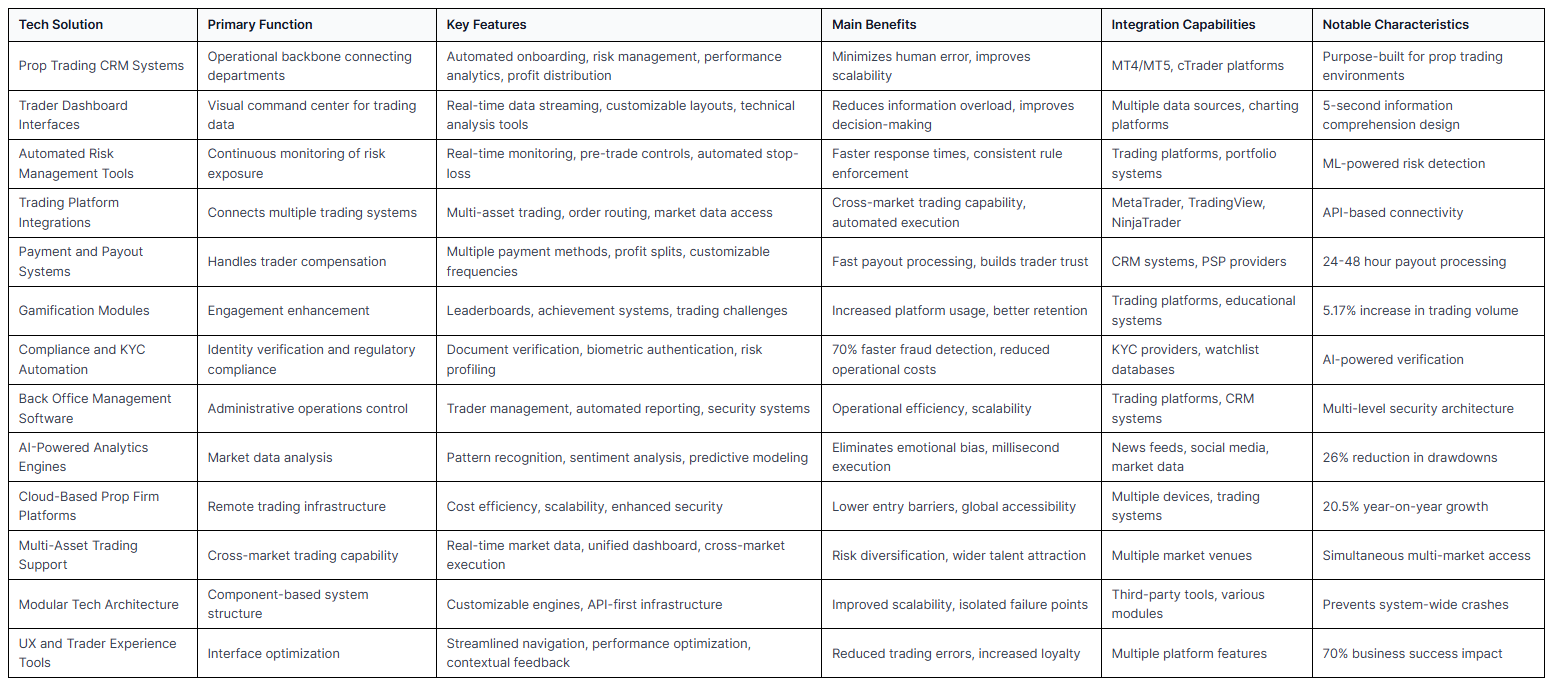
Comparison Table
Conclusion
After testing dozens of prop firm tech solutions in 2025, the winners prioritize integration, automation, and user experience. Focus on platforms offering seamless CRM integration, robust risk management, and fast payouts. The best prop firm tech creates an ecosystem that empowers traders while protecting capital and ensuring compliance.
FAQ
What's the most important prop firm tech feature?
Automated risk management. Without proper controls, traders can wipe out firm capital instantly. Look for real-time monitoring and automated stop-losses.
How much should firms budget for tech infrastructure?
$50,000-$200,000 annually depending on size. Cloud solutions reduce upfront costs significantly.
Can small firms compete technologically?
Yes. Cloud-based platforms give small firms access to enterprise-grade technology without massive investments.
Generic CRM vs prop trading CRM?
Prop CRMs are purpose-built with trader evaluation workflows, rule enforcement, and platform integrations that generic CRMs lack.
How long does implementation take?
3-6 months for complete systems. Modular approaches can reduce timelines with phased rollouts.
Are AI analytics worth it for smaller firms?
Yes. AI tools often pay for themselves within the first quarter through improved performance and reduced drawdowns.